Block Kit, signature verification, and the design decisions that stop a button click from becoming an incident.
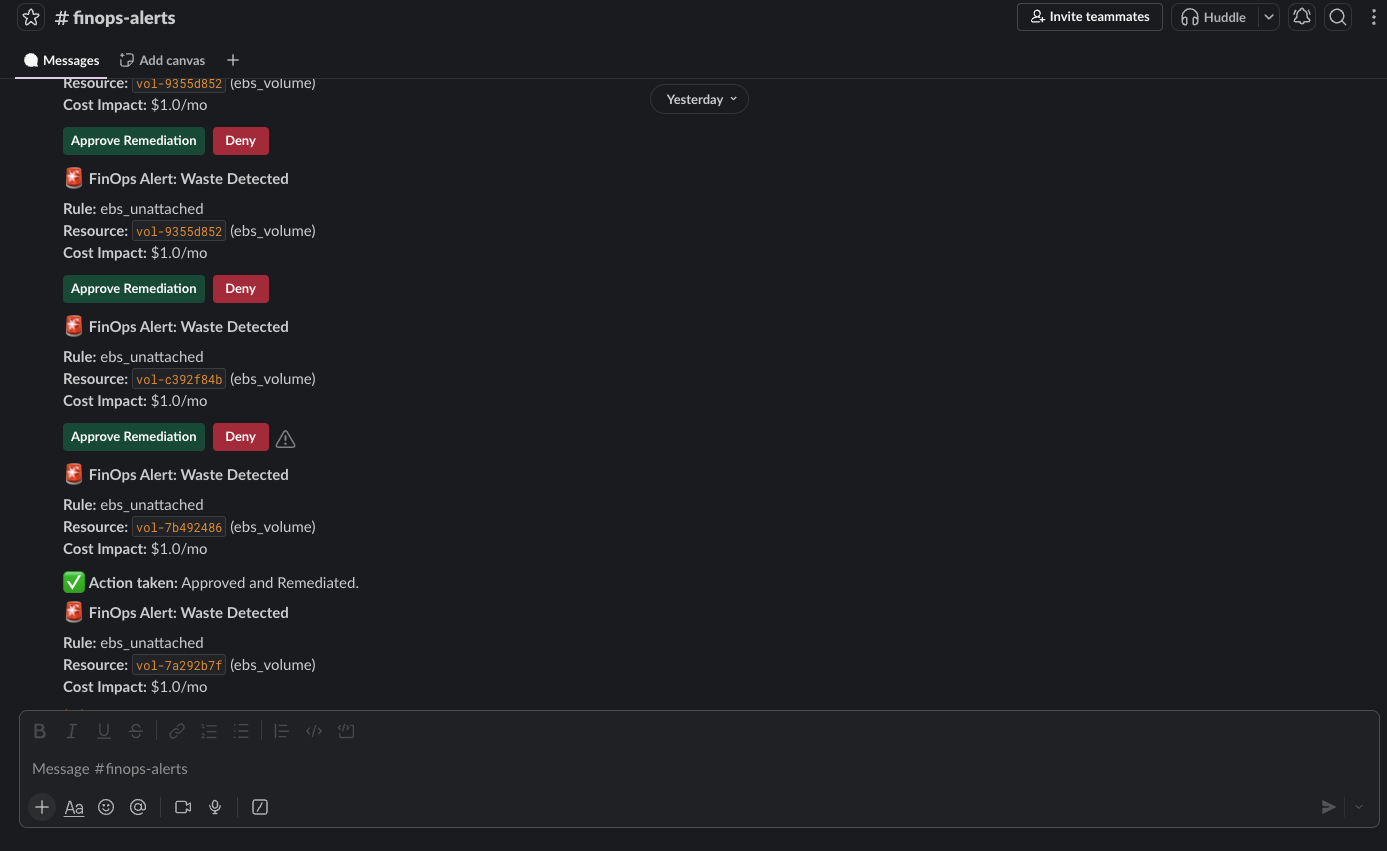
That screenshot is a bot asking permission to delete an EBS volume. Clicking Approve Remediation snapshots the volume, waits for the snapshot to complete, deletes the volume, and edits the message to say what happened.
Getting that to work is mostly plumbing. Getting it to work safely — so a stale click, a replayed request, or a resource someone protected in the meantime cannot cause damage — is the interesting part.
This walks through both, using the Slack adapter from FinOps Sentinel.
The shape of the problem
Slack interactivity is two separate channels that only look like a conversation:
Your app ──── incoming webhook ────▶ Slack channel
                                          │
                                     user clicks
                                          │
Your app ◀─── HTTP POST ──────────────────┘
             (a completely new request, from Slack's servers)
The click arrives as an unauthenticated POST from the public internet to whatever URL you registered. Nothing about the request proves it came from Slack, or that a human clicked anything. That is the security problem in one sentence, and everything below follows from it.
It also has a second half that took me a round of review to see. Proving the request came from Slack is not the same as proving the person may delete infrastructure, and neither one is AWS agreeing that they may. Three different questions, three different places to answer them — the adapter, the domain, and IAM.
Part 1: Setting up the Slack app
Create the app and get a webhook
- api.slack.com/apps → Create New App → From scratch
- Name it, pick your workspace
- Incoming Webhooks → toggle On → Add New Webhook to Workspace
- Choose a channel, click Allow, copy the URL
SLACK_WEBHOOK_URL=https://hooks.slack.com/services/TXXXXX/BXXXXX/XXXXXXXX
Webhooks post to exactly one channel and cannot read anything. For a notification bot that is the right amount of privilege — no OAuth flow, no bot token, no scopes to review.
Enable interactivity
Interactivity & Shortcuts → toggle On → set the Request URL:
https://your-domain.example/callbacks/slack
Locally you need a tunnel:
ngrok http 8000
# → https://a1b2c3d4.ngrok.app
# Request URL: https://a1b2c3d4.ngrok.app/callbacks/slack
The free ngrok URL changes on every restart, and you must update Slack each time. Save yourself the confusion: if buttons "do nothing," check this first.
Get the signing secret
Basic Information → App Credentials → Signing Secret → Show.
SLACK_SIGNING_SECRET=your_signing_secret_here
This is what makes callbacks trustworthy. Without it your endpoint will delete infrastructure for anyone who sends it a well-formed POST.
Part 2: Sending a message worth acting on
Block Kit messages are JSON arrays of blocks. The naive version works immediately:
from slack_sdk.webhook import WebhookClient

WebhookClient(webhook_url).send(text=f"Idle volume found: {volume_id}")
But an alert an engineer has to act on needs to answer what, where, how much, and what happens if I click this — in about ten seconds, often on a phone.
Here is the real implementation:
def send_finding_alert(self, finding: Finding, resource: Resource) -> str | None:
    webhook_url = settings.slack_webhook_url
    if not webhook_url:
        raise RuntimeError("SLACK_WEBHOOK_URL is not configured")

    remediable = is_remediable(finding.rule)
    header = (
        "*FinOps Alert: Waste Detected*"
        if remediable
        else "*FinOps Advisory: Possible Idle Resource*"
    )

    blocks: list[dict[str, Any]] = [
        {
            "type": "section",
            "text": {
                "type": "mrkdwn",
                "text": (
                    f"{header}\n\n"
                    f"*Rule:* {finding.rule}\n"
                    f"*Resource:* `{resource.resource_id}` ({resource.resource_type})\n"
                    # Region is not decoration: with several regions scanned, it is
                    # the first thing an approver needs to know where to look, and
                    # remediation runs there.
                    f"*Region:* `{resource.region}`\n"
                    f"*Cost Impact:* ${finding.est_monthly_cost_usd}/mo"
                ),
            },
        }
    ]
The region line was added after a real confusion. Scanning three regions produces three near-identical alerts differing only by resource ID. Without the region an approver cannot tell which account corner they are about to change.
The LLM summary goes in its own block
    if finding.llm_summary:
        # Advisor output is untrusted display copy (it summarizes
        # user-controlled tags), so it goes in its own context block and is
        # never used to build action values.
        blocks.append({
            "type": "context",
            "elements": [{"type": "mrkdwn", "text": finding.llm_summary}],
        })
A local LLM writes a plain-language explanation of each finding. The prompt contains AWS tags — which anyone with tagging permission can write. So model output is treated as untrusted display copy: rendered, never parsed, and never used to build anything the system acts on.
Buttons are conditional, and that is the whole design
    if remediable:
        blocks.append({
            "type": "actions",
            "elements": [
                {
                    "type": "button",
                    "text": {"type": "plain_text", "text": "Approve Remediation"},
                    "style": "primary",
                    "value": f"approve_{finding.id}",
                    "action_id": "approve_remediation",
                },
                {
                    "type": "button",
                    "text": {"type": "plain_text", "text": "Deny"},
                    "style": "danger",
                    "value": f"deny_{finding.id}",
                    "action_id": "deny_remediation",
                },
            ],
        })
    else:
        # Metric-inferred: no playbook is allowed to run, so offering an
        # Approve button would promise an action the domain refuses.
        blocks.append({
            "type": "context",
            "elements": [{
                "type": "mrkdwn",
                "text": ("_Advisory only — inferred from CloudWatch metrics. "
                         "No automated remediation is available for this rule._"),
            }],
        })
Some findings are advisory by design. An idle EC2 instance might be a warm standby, a batch worker between runs, or a license server — low CPU is evidence, not proof. The domain refuses to remediate those rules.
The early version rendered buttons on every alert. Clicking Approve on an advisory finding returned a refusal. A button that does nothing is worse than no button — it trains people to distrust every button. So the adapter asks the domain first and renders accordingly.
Notification preview text
    response = WebhookClient(webhook_url).send(
        # Notification preview text — the region belongs here too, since
        # this is all a phone lock screen shows.
        text=(f"FinOps Alert: {finding.rule} on {resource.resource_id} "
              f"in {resource.region}"),
        blocks=blocks,
    )
    if response.status_code != 200:
        raise RuntimeError(f"Slack webhook returned {response.status_code}: {response.body}")

    logger.info("Sent Slack alert for finding %s", finding.id)
    # Incoming webhooks return no message timestamp; edits happen via the
    # interaction payload's response_url instead.
    return None
Easy to forget: when blocks is present, text becomes the push-notification
preview. Omit it and phones show "This content can't be displayed."
Note the raise. A failed send is not swallowed — the caller leaves the finding unnotified so the next scan retries it. Swallowing would lose the alert silently, which for a cost alert means the money keeps burning and nobody knows.
Part 3: Receiving the click safely
Verify before you parse
def parse_callback(
    self, raw_body: bytes, headers: Mapping[str, str]
) -> tuple[Decision, dict[str, Any]]:
    self._verify_signature(raw_body, headers)     # ← first line, always
    ...
Signature verification is the first thing that happens. Parse-then-verify means you've already run a JSON decoder on hostile input.
CALLBACK_MAX_AGE_SECONDS = 60 * 5

def _verify_signature(self, raw_body: bytes, headers: Mapping[str, str]) -> None:
    secret = settings.slack_signing_secret
    if not secret:
        # No secret configured — verification bypassed (local testing).
        return

    timestamp = headers.get("x-slack-request-timestamp") or headers.get(
        "X-Slack-Request-Timestamp"
    )
    signature = headers.get("x-slack-signature") or headers.get("X-Slack-Signature")
    if not timestamp or not signature:
        raise PermissionError("Missing Slack signature headers")

    try:
        age = abs(time.time() - int(timestamp))
    except ValueError as exc:
        raise PermissionError("Invalid Slack timestamp header") from exc
    if age > CALLBACK_MAX_AGE_SECONDS:
        raise PermissionError("Slack request timestamp expired")

    verifier = SignatureVerifier(secret)
    if not verifier.is_valid(body=raw_body, timestamp=timestamp, signature=signature):
        raise PermissionError("Invalid Slack signature")
Three checks, three different attacks:
| Check | Stops |
|---|---|
| Headers present | Casual probing of a public endpoint |
| Timestamp within 5 minutes | Replay — a captured valid request resent later |
| HMAC valid | Forgery |
And one attack none of them stops, which took me an embarrassingly long time to see: a valid signature from someone who has no business deleting anything. More on that in Part 4 — it turns out to be the more interesting hole.
The replay check is the one people skip. A signature stays valid forever unless you bound its age; capture one legitimate approve callback and you can replay it indefinitely. Slack sends the timestamp precisely so you can reject stale requests.
SignatureVerifier comes from slack_sdk and does constant-time comparison —
worth using rather than hand-rolling HMAC and comparing with ==.
The if not secret: return bypass is a deliberate local-testing affordance,
and it is a landmine. It means an unconfigured deployment accepts anything.
Fine on a laptop, dangerous anywhere reachable. If I were hardening this for
production I would make it fail closed unless an explicit
ALLOW_UNSIGNED_CALLBACKS=true were set.
The signature proves the app, not the install
A signature says the request went through this app. It does not say which install of it. Add the app to a second workspace, or widen the channel, and well-signed approvals start arriving from a population nobody enumerated — every one of them passing all three checks above.
That is Slack-shaped, so it belongs in the Slack adapter, right next to the signature check:
def _verify_provenance(self, payload: dict[str, Any]) -> None:
    expected_team = settings.slack_team_id
    if expected_team:
        team_id = (payload.get("team") or {}).get("id")
        if team_id != expected_team:
            raise PermissionError(f"Callback from unexpected Slack workspace: {team_id!r}")

    allowed_channels = settings.allowed_slack_channels
    if allowed_channels:
        channel_id = (payload.get("channel") or {}).get("id")
        if channel_id not in allowed_channels:
            raise PermissionError(f"Callback from unexpected channel: {channel_id!r}")
team.id means nothing to a Telegram install — its equivalent is a chat id —
so this stays on the adapter side of the port. The question of whether the
person may delete infrastructure is different, and it goes somewhere else
entirely.
Raw bytes matter
@app.post("/callbacks/{channel}")
async def notifier_callback(channel: str, request: Request) -> dict[str, Any]:
    raw_body = await request.body()          # ← bytes, not a parsed model
    decision, reply_context = notifier.parse_callback(raw_body, request.headers)
The HMAC is computed over the exact bytes Slack sent. Let FastAPI parse the body into a Pydantic model first and you cannot reconstruct them — key order, whitespace, and encoding all shift. Signature verification will then fail mysteriously and you will lose an afternoon.
Parsing the payload
Slack sends application/x-www-form-urlencoded with a single payload field
containing JSON. Yes, really.
    form = urllib.parse.parse_qs(raw_body.decode("utf-8"))
    payload_values = form.get("payload")
    if not payload_values:
        raise ValueError("No payload found")

    try:
        payload = json.loads(payload_values[0])
    except json.JSONDecodeError as exc:
        raise ValueError("Payload is not valid JSON") from exc

    actions = payload.get("actions") or []
    if not actions:
        raise ValueError("No actions in payload")

    value = str(actions[0].get("value", ""))
    action: Literal["approve", "deny"]
    if value.startswith("approve_"):
        action, finding_id = "approve", value.removeprefix("approve_")
    elif value.startswith("deny_"):
        action, finding_id = "deny", value.removeprefix("deny_")
    else:
        raise ValueError(f"Unrecognized action value: {value!r}")

    actor = payload.get("user", {}).get("username") or payload.get("user", {}).get(
        "id", "unknown"
    )

    decision = Decision(
        finding_id=finding_id,
        actor=actor,
        action=action,
        decided_at=datetime.now(UTC),
        channel=self.channel_name,
    )
    reply_context = {
        "response_url": payload.get("response_url"),
        "original_blocks": payload.get("message", {}).get("blocks", []),
    }
    return decision, reply_context
The output is a domain object. Everything Slack-shaped — form encoding, the
payload wrapper, response_url — stops at this boundary. The domain service
receiving this Decision has no idea Slack exists.
The button value carries a system-generated finding ID, never model output and never anything a user typed. The parser refuses anything not matching the expected prefixes.
Mapping exceptions to status codes
    try:
        decision, reply_context = notifier.parse_callback(raw_body, request.headers)
    except PermissionError as exc:
        raise HTTPException(status_code=401, detail=str(exc)) from exc
    except ValueError as exc:
        raise HTTPException(status_code=400, detail=str(exc)) from exc
The port defines the exception contract — PermissionError for auth failures,
ValueError for malformed input — so any notifier implementation maps cleanly
to HTTP without the route knowing which one is configured.
Part 4: What happens after the click
The route hands off to the domain immediately:
def _decide(finding_id: str, action: str, actor: str, channel: str) -> bool:
    repo = get_repository()
    if action == "approve":
        return approve_finding(
            finding_id,
            repo,
            # A factory, not a gateway: the credentials depend on the approval
            # — its region, and whose role runs it.
            get_approval_gateway_factory(),
            actor=actor,
            channel=channel,
            dry_run=settings.dry_run,
            # Authority, checked in the domain: the notifier already proved the
            # request came through the app, which is a different question.
            authorizer=get_authorizer(),
        )
    return deny_finding(finding_id, repo, actor=actor, channel=channel)
Inside approve_finding, guardrails are re-checked at approval time, not
trusted from detection time:
    if authorizer is not None and not authorizer.can_approve(actor):
        _audit(repo, "approve_blocked_unauthorized", finding.id, {"actor": actor})
        return False

    if resource.lifecycle == ResourceLifecycle.DELETED:
        _audit(repo, "approve_blocked_resource_gone", finding.id, {...})
        return False

    if finding.protected or rules.is_protected(resource.current_tags):
        _audit(repo, "approve_blocked_protected", finding.id, {...})
        return False

    if not rules.is_remediable(finding.rule):
        _audit(repo, "approve_blocked_notify_only", finding.id, {...})
        return False

    playbook = rules.PLAYBOOK_ALLOWLIST.get(resource.resource_type)
    if playbook is None:
        _audit(repo, "approve_blocked_no_playbook", finding.id, {...})
        return False
An alert can sit in Slack for hours. In that window someone may have tagged the
resource finops:protected=true, or deleted it out of band. The newer intent
wins, and each refusal gets its own audit event name so "why didn't it act?"
is answerable from the database.
Authentication is not authorization
That first check is the one I originally didn't have, and its absence was the most serious thing in this system.
Signature verification proves the request came through the app. The signing
secret is app-level, so that proof is shared by everyone who can see the
message. I captured actor, stamped it into the Decision, and printed it in
"Approved by @boaz" — so the audit trail could answer who clicked, while the
system had never formed an opinion on whether that person was permitted to.
The check lives in the domain, not the adapter. approve_finding already
receives actor; putting the decision there means it survives the swap to
Telegram that the whole port arrangement exists to make possible. It gets its
own refusal path and its own audit event, because a denied attempt has to be as
visible in the log as an accepted one — otherwise the trail records only the
approvals that happened to be permitted.
The list is a config table (SENTINEL_APPROVERS), keyed on the Slack user
id rather than the username: display names are user-controlled, and this
string decides who gets to delete infrastructure.
The double-click problem, and the one I actually had
Slack buttons are trivially double-clickable, and Slack itself retries on timeout. Without protection you get two remediations. Here is what I originally wrote:
    if not repo.transition_finding(finding.id, finding.status, FindingStatus.APPROVED):
        return False  # lost the race — someone else already decided
Backed by a compare-and-swap:
UPDATE findings SET status = :new WHERE id = :id AND status = :expected
Returns True only when rowcount == 1. That protects the simultaneous case:
two requests that both read NOTIFIED, one of which loses.
It does not protect a replay, and a double-click is a replay. The second
click arrives after the first one committed, so it loads APPROVED, passes
expected=APPROVED, and runs:
UPDATE findings SET status='APPROVED' WHERE id=:id AND status='APPROVED'
That matches. rowcount == 1. Remediation runs again.
What saved me was a check one gate above — the transition table has no
APPROVED → APPROVED edge, so a replay is refused before it reaches the CAS.
But that means the guarantee I was advertising came from a different mechanism
than the one I was pointing at, and it holds only for as long as nobody adds a
self-loop to that table. The fix is to name the pre-decision state literally:
    if not repo.transition_finding(finding.id, FindingStatus.NOTIFIED, FindingStatus.APPROVED):
        return False  # already decided — a concurrent click, or a replayed one
Now APPROVED → APPROVED updates zero rows, which is the behaviour I claimed in
the first place.
A concurrency test cannot catch this; a sequential one catches it immediately. Approve once, let it commit, replay the identical payload, assert the fake cloud gateway saw exactly one delete:
def test_replayed_approval_executes_once(repository):
    seed(repository)
    gateway = FakeCloudGateway()
    payload = {"actor": "boaz", "channel": "slack", "dry_run": False}

    assert approve_finding("f-mock", repository, resolver(gateway), **payload) is True
    assert approve_finding("f-mock", repository, resolver(gateway), **payload) is False

    assert gateway.executed == [("snapshot_then_delete_volume", "vol-123", False)]
Three seconds versus a snapshot
The version of this article that shipped first put the remediation inline in the callback route, and buried the consequence in a troubleshooting note. The consequence deserves better than a note.
The EBS playbook snapshots the volume and waits for the snapshot before deleting — up to ten minutes. Slack gives up at three seconds and retries the interaction itself. Across that entire interval the message still carried its buttons, because the code that removes them ran after the playbook finished. So the acknowledgement window, the button removal, and the CAS all stopped covering the same interval, and the interval was as long as the remediation.
The fix is to split deciding from executing. Deciding is repository reads and one write:
plan = commit_approval(finding_id, repo, actor=actor, channel=channel,
                       authorizer=get_authorizer())
if plan is None:
    return _rejected(...)          # a guardrail refused, or it was already decided

notifier.confirm_decision(reply_context, f"⏳ *Approved* by @{actor} — running "
                                         f"`{plan.playbook}`{where}.")
background_tasks.add_task(_run_remediation, plan, notifier, reply_context, actor, where)
return {"message": "accepted"}     # well inside the 3-second budget
The ordering is the point: the finding is APPROVED in the database before
the acknowledgement goes out. The state change that makes a replay a no-op and
the edit that removes the buttons land together, rather than a remediation
apart. The playbook then runs in the background and edits the message a second
time with the outcome.
Editing the message
def confirm_decision(self, reply_context: dict[str, Any], text: str) -> None:
    response_url = reply_context.get("response_url")
    if not response_url:
        return

    blocks: list[dict[str, Any]] = []
    original_blocks = reply_context.get("original_blocks") or []
    if original_blocks:
        blocks.append(original_blocks[0])  # keep the alert text, drop the buttons
    blocks.append({"type": "section", "text": {"type": "mrkdwn", "text": text}})

    response = WebhookClient(response_url).send(
        text=text, blocks=blocks, replace_original=True
    )
    if response.status_code != 200:
        logger.error("Failed to update Slack message: %s", response.body)
Keeping block [0] and dropping the rest preserves the context — what the alert
was — while removing the buttons so a decided finding cannot be clicked again.
response_url is valid for 30 minutes and 5 uses, which is plenty for one edit.
The outcome text distinguishes every terminal state:
outcome = f"⏳ *Approved* by @{actor} — running `{plan.playbook}`{where}."   # the ack
outcome = f"*Approved* by @{decision.actor} — remediation executed{where}."
outcome = f"*Approved* by @{decision.actor} — DRY RUN, no resources were changed."
outcome = f"*Denied* by @{decision.actor} — no action taken, finding closed."
outcome = f"*Remediation failed*{where} after approval by @{decision.actor} — ..."
"Approved" alone does not tell an operator whether anything actually changed.
The guardrail I couldn't write in Python
Everything above is Sentinel deciding whether Sentinel should act. None of it is AWS deciding whether a person may delete a volume.
That distinction matters because the deletion runs with the app's own
credentials. An approver list is a string comparison; the DeleteVolume call
behind it is made by a principal that holds that permission permanently, for
every approval, whoever clicked. Someone on the list with zero IAM access still
deletes the volume. Someone with account admin but not on the list is refused.
The two facts are unrelated — a textbook confused deputy, where the click is
only a trigger.
Making AWS the enforcement point means the approval has to run as the
approver. SENTINEL_ASSUME_ROLE=true maps each actor to a role, and every
approval calls sts:AssumeRole with three things attached:
RoleSessionName=sentinel-U024BE7LH— CloudTrail records a session naming the human, not a shared service principal.- An
ExternalIdon the trust policy, so the role cannot be assumed by anything that doesn't hold the secret even if its ARN leaks. - An inline session policy scoped to this one approval. Sentinel already
knows the playbook, the resource and the region, so the session it runs under
can do
ec2:DeleteVolumeon exactly one volume ARN for fifteen minutes. STS intersects it with the role's own permissions, so it can only narrow: the approver's role may be broad, and the session that runs this deletion is not.
Sentinel's own role then drops to read-only plus sts:AssumeRole. A leaked
Sentinel credential can inventory the account and nothing else.
The limit is worth stating rather than glossing: the actor-to-role mapping is Sentinel asserting an identity from a Slack payload. AWS enforces what the resulting session may do; it never sees the Slack user. The chain is as strong as the Slack account and the signature check in front of it. That is a real improvement over a name list, and it is not the same thing as the approver authenticating to AWS — "IAM enforces it" implies more than is true.
One testing note, because it is a trap: LocalStack Community evaluates no IAM policies. It issues a session for any role ARN and then permits whatever that session asks. A "denied" assertion there passes the deletion — a green test for an enforcement that never ran. Test the wiring against LocalStack, test the refusals against a fake STS, and verify enforcement once by hand in a sandbox account.
Part 5: Testing without a workspace
The whole flow is testable with no Slack account at all, because the notifier is a port:
class FakeNotifier(Notifier):
    """Records what was sent. Zero Slack, zero HTTP."""

    def __init__(self):
        self.alerts: list[tuple[str, str]] = []
        self.digests: list[tuple[str, list[str]]] = []

    @property
    def channel_name(self):
        return "fake"

    def send_finding_alert(self, finding, resource):
        self.alerts.append((finding.id, resource.resource_id))
        return f"msg-{len(self.alerts)}"

    def send_digest(self, title, sections):
        self.digests.append((title, sections))
        return f"digest-{len(self.digests)}"
The approve-and-remediate flow runs against FakeNotifier + a fake cloud
gateway + an in-memory repository. If that passes, swapping Slack for Telegram
cannot break the approval logic — because the approval logic never knew about
Slack.
For the adapter itself, mock the webhook client and assert on the blocks:
def send_and_capture(finding, resource):
    """Send an alert through a mocked webhook and return the blocks sent."""
    settings.slack_webhook_url = "https://hooks.slack.test/T/B/X"
    try:
        with patch("finops_sentinel.adapters.notifications.slack.WebhookClient") as client_cls:
            client_cls.return_value.send.return_value = MagicMock(status_code=200, body="ok")
            SlackAdapter().send_finding_alert(finding, resource)
            return client_cls.return_value.send.call_args.kwargs["blocks"]
    finally:
        settings.slack_webhook_url = None


def test_advisory_findings_get_no_buttons():
    blocks = send_and_capture(make_finding("ec2_idle"), resource)
    assert not any(b["type"] == "actions" for b in blocks)
That test encodes a product decision, not an implementation detail. It fails if someone later adds buttons to advisory alerts, which is exactly when you want to be interrupted.
Troubleshooting
| Symptom | Cause |
|---|---|
401 Invalid Slack signature | Secret mismatch, or the body was parsed before verification |
| Buttons do nothing | Request URL doesn't match your current tunnel; ngrok rotates on restart |
This content can't be displayed on mobile | Missing text= fallback alongside blocks= |
| Timeouts | Slack wants 200 OK within 3 seconds; do slow work after responding |
| Message never edits | response_url expired (30 min / 5 uses) |
| Duplicate remediations | CAS passing the status you just read instead of the literal pre-decision one |
| Well-signed approvals from strangers | No team.id / channel check, and no approver list |
On the 3-second rule: the state transition is a single indexed UPDATE and
finishes well inside the budget — but the remediation does not, and that is
the part that matters. Commit the decision, acknowledge, remove the buttons,
then do the slow work in the background. Acknowledging late means Slack retries
into a message whose buttons are still live, and now you are relying on
idempotency you may not have.
What I would do differently
Fail closed on a missing signing secret. The bypass is convenient locally and dangerous everywhere else.
Use a bot token instead of an incoming webhook. Webhooks return no message
timestamp, so editing depends on response_url and its 30-minute window. A bot
token gives you chat.update on any message, any time.
Add a confirmation dialog for high-impact actions. Block Kit supports a
native confirm object on buttons — one extra tap between a mis-tap and a
deleted database.
Put the remediation on a durable queue. Backgrounding it inside the web
process closed the acknowledgement window, but a restart mid-remediation strands
the finding in APPROVED with no message update. Fine for one process; wrong
for anything that redeploys often.
Check authority on deny, too. Denying is the safe direction, so I gated approve first — but denial is terminal, which means anyone who can see the message can quietly close a finding nobody ever acts on.
The takeaway
The Slack integration is about 260 lines. Roughly a third is Block Kit formatting, a third is signature verification, and a third is turning payloads into domain objects.
What makes it safe is not in the Slack code at all. It is that a button click is a request, not a command — the domain re-checks every guardrail, asks whether this actor may approve at all, uses a compare-and-swap against the literal pre-decision status so neither a race nor a replay can execute twice, and refuses outright when the rule was never remediable.
And the guarantee that matters most isn't in the code either. It is in IAM: the session that runs the deletion belongs to the approver, is scoped to one resource, and expires in fifteen minutes.
Slack is the driving adapter. The safety lives inside — and, for the last mile, in the account.
Corrections and thanks
This article has been revised. The original claimed the compare-and-swap made
double-clicks safe, and it did not: passing finding.status as the expected
value makes the update a tautology on a replay, and a double-click is a
replay, not a race. The original also treated signature verification as if it
answered a question about the person clicking, which it never did.
Both were pointed out by anp2network in the comments — precisely, with the failing sequence spelled out and the test that would have caught it. That feedback prompted the fixes described above: the literal CAS precondition and its sequential replay test, the domain-side authority check with its own audit event, the workspace and channel provenance checks in the adapter, moving the remediation off the request path, and ultimately the assume-role work that moved enforcement from a name list into IAM.
The best kind of comment is the one that costs you a weekend. Thank you.
Full source: github.com/boazleleina/finops-sentinel — see adapters/notifications/slack.py, docs/iam-policies.md and SLACK_SETUP.md.